Companion journey · part five
The History of the Bible,
from Moses to your phone.
How did a text written on leather scrolls more than three thousand years ago reach the Bible you open this morning? Across nine panels, eight colour-coded threads and 53 milestones, we trace its transmission through languages, scribes, translators, printers, and the churches that, generation after generation, received the Word and passed it on.
How to read it · the eight threads
- Hebrew and the Old Testament
- Greek: the Septuagint and the New Testament
- Latin: the Vulgate
- Vernacular languages before the Reformation
- French Protestant Bibles
- French Catholic Bibles
- Manuscripts, scholarship and textual criticism
- The wider world: printing, Bible societies and every language
As in the timeline of the main dossier, each thread begins at its first milestone and runs through to its last. A dot marks each event, and its title takes on the colour of the corresponding thread. The relevant thread appears at full opacity, while the others fade into the background. To the left are the date, place and, when available, a portrait. Early dates are approximate. The panels are designed to be read in sequence, but each can also stand on its own.
Panel One · From the origins to the first century
At the Origins: From Hebrew Scrolls to the Septuagint
Each coloured thread follows a language or a family of Bibles: Hebrew, Greek, Latin, vernacular languages, then French Protestant and Catholic Bibles, scholarship, and the wider world. A dot marks each event, and its title adopts the colour of the thread. Early dates are approximate.
-
Hebrew and the Old Testament — The Torah committed to writing
Israelite tradition attributes the Law (Torah) to Moses. The five books are copied onto leather scrolls and read aloud to the assembled people. Alphabetic writing, which emerged in Canaan, makes it possible for a text to be heard and learned by the whole community.
-
Hebrew and the Old Testament — Prophets, Psalms and Wisdom
The historical books, the prophets, the Psalms of David and the wisdom of Solomon are added alongside the Law. After the Babylonian exile, the scribe Ezra reads the Law publicly before the assembled people (): the Bible is already a book read in public.
-
Greek: the Septuagint and the New Testament — The Septuagint: the Bible Speaks Greek
For Jews in Egypt who no longer read Hebrew, the Law, followed by the other books of the Old Testament, is translated into Greek. This “version of the Seventy”, the Septuagint, will become the Bible of the earliest Christians and the form of Scripture most frequently quoted by New Testament authors.
-
Hebrew and the Old Testament — The Dead Sea Scrolls
A Jewish community copies and preserves nearly a thousand manuscripts in jars, including a complete scroll of Isaiah. Discovered in 1947, they show a Hebrew text that is, in essentials, already the one the copyists would hand down for a thousand years, alongside other, rarer forms.
-
Vernacular languages before the Reformation — The Targums: Translation in the Synagogue
In synagogues, an interpreter renders each Hebrew verse into Aramaic, the spoken language. The Talmud traces this practice back to Ezra: in its interpretation, the word “distinctly” in points to translation. An Aramaic Targum of Job was discovered at Qumran, while the written Targums of Onkelos (the Law) and Jonathan (the Prophets) preserve this tradition.
-
Hebrew and the Old Testament — The Scriptures Known to Jesus
Jesus reads Isaiah in the synagogue at Nazareth () and refers to “the Law of Moses, the Prophets, and the Psalms” (). Israel’s Scriptures carry authority; rabbis continue to debate the status of some of the Writings, including the Song of Songs and Ecclesiastes. The apostles proclaim the Scriptures in Hebrew, Aramaic and Greek.
Jewish and Christian WitnessesCopying, counting, translating: what the Jewish masters tell usTalmud and Mishnah · four annotated texts
Long before the printers, the Jewish tradition reflected on the copying and translation of Scripture. Four texts from the Talmud and the Mishnah, composed between the second and the sixth centuries, show what was said on the matter.
1. Translating from Ezra onwards
Babylonian Talmud, Nedarim 37b and Megillah 3a
Nehemiah relates that the Levites “read in the book in the law of God distinctly, and gave the sense” (King James Version) (). For Rav, the Hebrew word מְפֹרָשׁ, “distinctly”, denotes the targum, the Aramaic translation delivered aloud. The Talmud then attributes the targum of the Law to Onkelos and that of the Prophets to Jonathan ben Uzziel.
2. The seventy-two translators
Babylonian Talmud, Megillah 9a; tractate Soferim 1:7
“King Ptolemy gathered seventy-two elders and had them enter seventy-two houses, without telling them why. He went to each of them and said: Write for me the Torah of Moses your master. The Holy One, blessed be He, put wisdom into the heart of each, and all agreed upon one and the same sense.”
Megillah 9a, free translation from the Aramaic
The account adds that they all wrote “God created in the beginning” instead of “In the beginning created God” (): this is the very order that Olivétan would adopt in 1535. Yet the Greek of the Septuagint that we possess keeps the Hebrew order: the Talmud reports a tradition, not the Greek text. Another tractate, which speaks of five elders, judges the same undertaking severely: that day was “as hard for Israel as the day the golden calf was made, for the Torah could not be translated as it ought to be”.
3. Counting the letters
Babylonian Talmud, Kiddushin 30a
“The ancients were called soferim, because they counted all the letters of the Torah.”
Kiddushin 30a, free translation (a play on words: sofer, “scribe”, and safar, “to count”)
The Talmud specifies that the ו (vav) of the word גָּחוֹן, “belly”, in marks the exact midpoint of the letters of the Torah. The Masoretes would later record this kind of tally in the margins of their manuscripts.
4. Which books are holy?
Mishnah, Yadayim 3:5; Babylonian Talmud, Bava Batra 14b
A holy book “defiles the hands”: one washes one’s hands after touching it. The Mishnah affirms this of all the Scriptures, then reports a debate: according to Rabbi Judah, Ecclesiastes is disputed; according to Rabbi Yose, the Song of Songs; Rabbi Akiba settles the matter: “all the Writings are holy, but the Song of Songs is the holy of holies”. The Talmud then gives the order of the Prophets and the Writings, from Ruth to Chronicles.
Fact: translating the Bible is a Jewish practice well before the Church: Aramaic targums in the synagogue, the Greek Septuagint in Alexandria.
Fact: the care taken in copying (counted letters, tallies in the margins) is attested by the rabbinic texts themselves.
Interpretation: the accounts concerning Ezra and the seventy-two translators are late traditions, which speak above all of the value attached to these practices.
Bible verses are quoted from the Berean Standard Bible (BSB), or from the King James Version where stated; the French editions are read on the author’s Bible server. Jewish texts read on Sefaria, Christian texts on TheologAI; unless otherwise stated, their English renderings are free translations made for this journey.
The History of the Bible · a timeline in nine panels · 2026 editionI — IX
Panel Two · First to fifth centuries
The New Testament and the canon
In less than a century, letters and Gospels are written, copied and exchanged between the Churches. Three centuries later, the list of books is settled and the Western Church receives its Latin Bible.
-
Greek: the Septuagint and the New Testament — The letters of Paul
The earliest Christian writings are letters dictated to Churches and read aloud in the assembly, then exchanged (). Peter already ranks them with “the rest of the Scriptures” ().
-
Greek: the Septuagint and the New Testament — The four Gospels and Revelation
Mark, Matthew, Luke (with Acts) and then John set down in writing the testimony of the apostles. The oldest known fragment, papyrus P52 (John 18), is generally dated to the 2nd century; its exact date remains a matter of debate.
-
Manuscripts, scholarship and textual criticism — A list of the received books
The Muratorian Fragment lists the writings read in the Church of Rome; in Lyon, Irenaeus defends “the fourfold Gospel”. The Churches recognise books they have received; they do not manufacture them.
-
Vernacular languages before the Reformation — Latin, Syriac, Coptic, Gothic: the first versions
Even before Jerome, the Churches translate: “Old Latin” versions circulate in North Africa and Italy, the Peshitta gives the Bible in Syriac, Coptic versions arise in Egypt and, around 350, Bishop Wulfila devises an alphabet in order to translate the Bible into Gothic. Augustine recommends the “Itala” and the Septuagint.
-
Manuscripts, scholarship and textual criticism — The great codices: Vaticanus and Sinaiticus
Two almost complete Greek Bibles, copied on parchment as a bound book (codex) and no longer as a scroll. They remain today the principal witnesses to the text; the Sinaiticus will be rediscovered in 1844.
-
Greek: the Septuagint and the New Testament — Athanasius sets out the list of the 27 books
In his Easter letter, the bishop of Alexandria gives for the first time the exact list of the twenty-seven books of the New Testament as we have them; the councils of Hippo (393) and Carthage (397) confirm it.
-
382–405Rome, Bethlehem
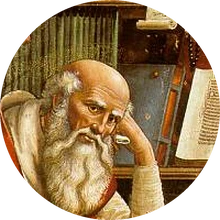
Latin: the Vulgate — Jerome and the Vulgate
At the request of Pope Damasus, Jerome revises the old Latin Bibles and then, settled in Bethlehem, translates the Old Testament directly from the Hebrew: “the Hebrew truth”. His Vulgate will be the Bible of the West for a thousand years.
Jewish and Christian WitnessesThe Septuagint or the “Hebrew truth”? Augustine, Jerome and the Bible of JesusAugustine, Jerome · Isaiah 61 and Luke 4 compared
When Jerome retranslated the Old Testament from the Hebrew, not everyone applauded. The debate that set him against Augustine runs through the whole history of the Bible.
1. Augustine defends the Septuagint
Augustine of Hippo, On Christian Doctrine II, 15, 22 (c. 396)
“Now among translations themselves the Italian (Itala) is to be preferred to the others, for it keeps closer to the words without prejudice to clearness of expression. And to correct the Latin we must use the Greek versions, among which the authority of the Septuagint is pre-eminent as far as the Old Testament is concerned.”
NPNF translation (1887)
Augustine also relates the tradition according to which the translators, each isolated in a cell, produced an identical text, “as with one voice”. Even where the Hebrew differs, he sees in this a dispensation of Providence in favour of the nations.
2. Jerome chooses the Hebrew
Jerome, at Bethlehem (390–405)
Jerome, for his part, wished to go back to the “Hebrew truth”. In a letter to Jerome (Letter 71, c. 403), Augustine recounts that at Oea, in Africa, the reading of Jonah in the new translation, with “ivy” in place of the customary “gourd”, provoked an uproar in the congregation. Changing the Bible one hears every Sunday has never been simple.
3. An example to verify: the Bible of Jesus
Bible server: Isaiah 61:1 (Hebrew) and Luke 4:18–19 (Greek)
| Isaiah 61:1, from the Hebrew | Luke 4:18–19, quoting Isaiah |
|---|---|
| “to proclaim liberty to the captives and freedom to the prisoners” () | “to proclaim liberty to the captives and recovery of sight to the blind” () |
Here Luke follows the Septuagint, which reads “recovery of sight to the blind”. Both readings have been received as Scripture: the New Testament frequently quotes the Greek Bible, and the Reformation would return to the Hebrew, as Jerome did.
Fact: the New Testament very often quotes the Old Testament according to the Septuagint (here Luke 4:18–19).
Fact: Jerome retranslated from the Hebrew despite Augustine’s reservations; the Reformation and Olivétan took up this principle.
Interpretation: the way in which the authority of the Hebrew and that of the Septuagint are to be articulated remains a matter of debate among Christian traditions.
Bible verses are quoted from the Berean Standard Bible (BSB), or from the King James Version where stated; the French editions are read on the author’s Bible server. Jewish texts read on Sefaria, Christian texts on TheologAI; unless otherwise stated, their English renderings are free translations made for this journey. Augustine is quoted in the English NPNF translation (1887).
The History of the Bible · a timeline in nine panels · 2026 editionII — IX
Panel Three · Sixth to fourteenth centuries
The Middle Ages: copying, ordering, translating
For a thousand years, the Bible is a precious manuscript, copied in the monasteries. The Masoretes fix the Hebrew text, the universities divide it into chapters, and already lay people want to read it in their own language.
-
Latin: the Vulgate — The Codex Amiatinus
The oldest complete Latin Bible to survive: more than a thousand leaves of parchment, copied by Anglo-Saxon monks to be presented to the pope. Around 800, Alcuin, at the court of Charlemagne, standardises the text of the Vulgate for the whole empire.
-
Hebrew and the Old Testament — The Masoretes: Aleppo and Leningrad
The Jewish scholars of Tiberias add vowels and accents to the Hebrew text, until then written in consonants alone, and record in the margins the letter-counts inherited from the scribes. The Aleppo Codex (c. 930) and the Leningrad Codex (1008) are the basis of all modern Hebrew Bibles.
-
c. 1170–1180Lyon
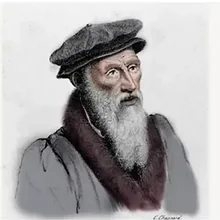
Vernacular languages before the Reformation — Waldo has the Gospel translated in Lyon
The Lyon merchant Peter Waldo pays two clerics to translate books of the Bible into the language of the country. The “Poor of Lyon” preach Scripture to the people; condemned, they survive in the Alpine valleys until Chanforan (1532).
-
Manuscripts, scholarship and textual criticism — Chapters and the Paris Bible
Stephen Langton divides the Bible into chapters, the very ones we still use. The booksellers of the University of Paris produce portable single-volume Bibles with a standardised order of books: the Bible becomes an object one can consult.
-
Vernacular languages before the Reformation — The Bible historiale of Guyart des Moulins
A canon translates and adapts the biblical story into French, from the Vulgate and a Latin handbook. Copied in hundreds of exemplars, often illuminated, it is the French Bible of princes and wealthy lay people until the coming of printing.
-
1382–1395Oxford
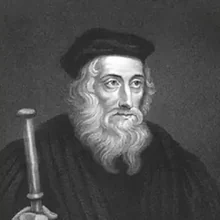
Vernacular languages before the Reformation — Wycliffe: the Bible in English
John Wycliffe and his followers translate the whole Vulgate into English, copied by hand and circulated by the Lollards despite the ban. A century before printing, the principle is set down: the people must be able to read Scripture.
The History of the Bible · a timeline in nine panels · 2026 editionIII — IX
Panel Four · 1450–1534
Printing and the return to the sources
In eighty years, everything changes: the press multiplies books, the humanists re-edit the Hebrew and the Greek, and the Reformation puts the Bible into everyone’s hands.
-
1454–1455Mainz
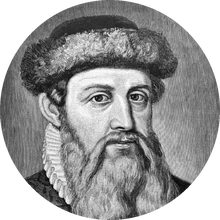
The wider world: printing, Bible societies and every language — The Gutenberg Bible
The first great book printed in the West is the Vulgate: around 180 copies in two volumes. Bibles become more numerous and cheaper, and an error corrected on the press no longer spreads from copy to copy.
-
Hebrew and the Old Testament — The first printed Hebrew Bible
A family of Jewish printers publishes the complete Hebrew Bible with vowels. In 1524–1525, the second Rabbinic Bible of Venice (Bomberg) will provide the text taken up by all the translators of the Reformation, Olivétan included.
-
1514–1522Alcalá de Henares, Basel
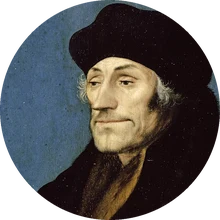
Greek: the Septuagint and the New Testament — The Alcalá Polyglot and Erasmus’s New Testament
In Spain, Cardinal Cisneros prints the Bible in parallel columns of Hebrew, Greek and Latin. In Basel, in 1516, Erasmus publishes the first Greek New Testament to be put on sale, with a new Latin translation: this is the Greek text that Luther, Tyndale and Olivétan will read.
-
1522–1534Wittenberg
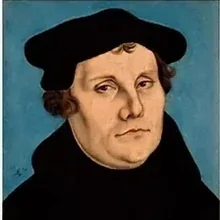
The wider world: printing, Bible societies and every language — Luther: the German Bible
Taking refuge at the Wartburg, Luther translates the New Testament from the Greek in eleven weeks; the complete Bible appears in 1534. His living language forges modern German and provides the model for the Bibles of the Reformation.
-
1523–1530Meaux, Antwerp
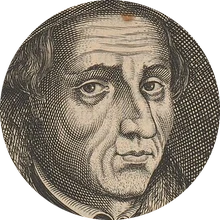
French Catholic Bibles — Lefèvre d’Étaples: the Bible in French
The humanist Jacques Lefèvre d’Étaples translates the New Testament (1523) and then the whole Bible (Antwerp, 1530), from the corrected Vulgate. Banned in France, it serves as the basis for Olivétan’s New Testament and for the Catholic Bible of Louvain.
-
1526–1536Worms, Antwerp, Vilvoorde
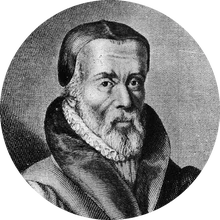
Vernacular languages before the Reformation — Tyndale, martyr translator
In exile, William Tyndale prints an English New Testament translated from the Greek, which is smuggled into England. Arrested near Brussels, he is strangled and burnt in 1536; his translation will pass in large part into the King James Bible.
The History of the Bible · a timeline in nine panels · 2026 editionIV — IX
Panel Five · 1535–1600
Olivétan and the French Geneva Bible
At Neuchâtel and then at Geneva the French Protestant lineage is born: a translation from the Hebrew and the Greek, revised without respite, divided into verses, annotated for the ordinary reader.
-
1532Chanforan (Piedmont)
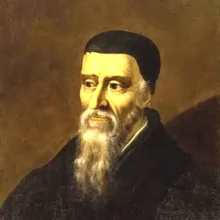
French Protestant Bibles — The Synod of Chanforan
The Waldensians of the valleys meet Guillaume Farel and decide to have the Bible translated into French from the original languages, at their own expense. Calvin’s cousin, Pierre Robert, known as Olivétan, is entrusted with the work.
-
4 June 1535Neuchâtel (Serrières)
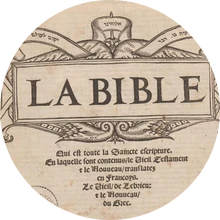
French Protestant Bibles — The Olivétan Bible
Pierre de Vingle completes the printing of a great Gothic folio: the first French Old Testament translated from the Hebrew, a New Testament revised against the Greek, the Apocrypha set apart, a Latin preface by Calvin. The root stock of all French Protestant Bibles.
-
1540–1551Geneva
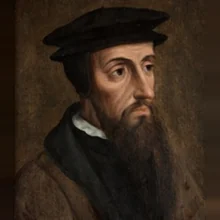
French Protestant Bibles — The Geneva revisions
Jean Girard reprints the Bible in roman type (the “Bible de l’Épée”, or Sword Bible, 1540); Calvin himself lends a hand to the revisions of 1546 and 1551. The text gains in clarity with every edition.
-
Latin: the Vulgate — The Council of Trent and the Vulgate
In the face of the Reformation, the Council receives the deuterocanonical books into the canon, declares the Vulgate “authentic” for teaching and preaching, and makes the printing of Bibles subject to the approval of the bishops. The official Vulgate, known as the Sixto-Clementine, appears in 1592 and will remain the Catholic point of reference until the Nova Vulgata (1979).
-
French Catholic Bibles — The Louvain Bible
In answer to the Protestant Bibles, the theologians of Louvain publish a French Catholic Bible, a revision of Lefèvre d’Étaples against the Vulgate. Approved by the theologians of Louvain and published under imperial privilege, it will be reprinted for a century.
-
1551–1553Geneva
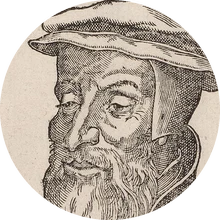
Manuscripts, scholarship and textual criticism — Robert Estienne numbers the verses
The King’s Printer, a refugee in Geneva, divides the Greek New Testament (1551) and then the whole French Bible (1553) into numbered verses. Concordances, catechisms and reading by reference become possible.
-
1560–1588Geneva
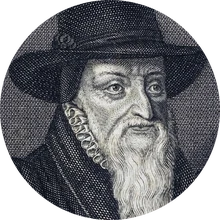
French Protestant Bibles — The French Geneva Bible
The pastors of Geneva, Theodore Beza and Simon Goulart at their head, revise the whole: notes, summaries, and Olivétan’s choice for the divine name, “l’Éternel” (“the Eternal One”), now adopted throughout. The French Geneva Bible of 1588 will remain the point of reference for the French-speaking Reformed Churches for more than a century.
Jewish and Christian WitnessesThe Apocryphal Books: Set Apart, Read or RejectedSix texts, from Olivétan (1535) to Westminster (1646)
In 1535, Olivétan sets apart, between the two Testaments, the books which the Septuagint and the Vulgate contain but of which the Hebrew Bible knows nothing (Tobit, Judith, Wisdom, Sirach, Maccabees…). Here is how the great confessions received them.
| Text | Date | What it says of these books |
|---|---|---|
| Olivétan Bible | 1535 | Printed separately, under the title of “apocrypha”. |
| Council of Trent, Session IV | 1546 | Received into the canon on the same footing as the others; the Vulgate is declared “authentic”. |
| Confession of Faith of the Reformed Churches of France, art. 4 | 1559 | “Ecclesiastical” books: “although they are useful, no article of faith can be founded” upon them. |
| Belgic Confession, art. 6 | 1561 | The Church may read them and draw instruction from them “so far as they agree with the canonical books”, without deriving from them any point of faith. |
| Thirty-Nine Articles (Church of England), art. 6 | 1562 | “The other Books (as Hierome saith) the Church doth read for example of life and instruction of manners; but yet doth it not apply them to establish any doctrine.” |
| Westminster Confession, ch. 1, § 3 | 1646 | “Not being of divine inspiration”, they “are no part of the canon of Scripture” and “of no authority in the Church of God”. |
The same Westminster Confession (ch. 1, § 8) sums up the principle which guided Olivétan and the Reformers:
“The Old Testament in Hebrew […], and the New Testament in Greek […], being immediately inspired by God, and by his singular care and providence kept pure in all ages, are therefore authentical; […] But because these original tongues are not known to all the people of God […], therefore they are to be translated into the language of every people unto which they come.”
Westminster Confession (1646), ch. 1, § 8
Fact: from 1535 onwards, the French Protestant Bible sets these books apart; Trent (1546) receives them fully into the canon.
Fact: the Protestant confessions range from an edifying use (England, Netherlands) to a denial of authority (Westminster).
Interpretation: the disagreement concerns the authority of these books, not their antiquity; the TOB of 2010 brings them together in a single volume.
Bible verses are quoted from the Berean Standard Bible (BSB), or from the King James Version where stated; the French editions are read on the author’s Bible server. Jewish texts read on Sefaria, Christian texts on TheologAI; unless otherwise stated, their English renderings are free translations made for this journey. Trent and the Belgic Confession are read on TheologAI; the Thirty-Nine Articles and the Westminster Confession are quoted in their original English; the Confession of 1559 is rendered from its French text.
The History of the Bible · a timeline in nine panels · 2026 editionV — IX
Panel Six · 1600–1830
Refuge, Enlightenment and Bible societies
Driven out of France, the Protestants revise their Bible in Amsterdam and Neuchâtel; the Catholics of Port-Royal give classical French its great translation; then the Bible societies invent mass distribution.
-
The wider world: printing, Bible societies and every language — The King James Bible
Forty-seven scholars revise the earlier English translations, Tyndale first among them, for King James I. The King James Version becomes the Bible of the English-speaking world and of its missions for three centuries.
-
1667–1696Port-Royal, Paris
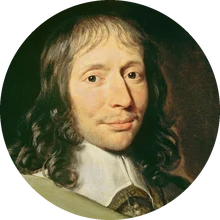
French Catholic Bibles — The Sacy Bible
Louis-Isaac Lemaistre de Sacy, translating in the Bastille and then at Port-Royal, gives the classic Catholic Bible in French, based on the Vulgate. His elegant prose will nourish Racine, Pascal and two centuries of readers.
-
French Protestant Bibles — The David Martin Bible
A pastor who took refuge in Utrecht after the revocation of the Edict of Nantes (1685), Martin revises the French Geneva Bible against the original texts for the Churches of the Refuge. His version is still in print today.
-
French Protestant Bibles — The Ostervald Bible
Jean-Frédéric Ostervald, pastor of Neuchâtel, publishes a clear revision of the French Geneva Bible and of Martin, with arguments and reflections. It will be the Bible of French Protestants until Segond, notably during the Réveil (the Revival).
-
The wider world: printing, Bible societies and every language — The Bible societies
The British and Foreign Bible Society (1804) and then the Protestant Bible Society of Paris (1818) print and distribute low-cost Bibles, without notes, in every language. Colporteurs and missions carry them as far as the villages.
The History of the Bible · a timeline in nine panels · 2026 editionVI — IX
Panel Seven · 1830–1910
The nineteenth century: rediscovered manuscripts and Louis Segond
Scholars go back to the oldest manuscripts while the Churches call for a new translation. Louis Segond answers both expectations.
-
1844–1859Mount Sinai
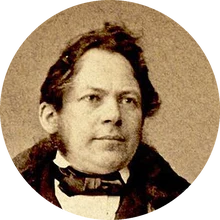
Manuscripts, scholarship and textual criticism — Tischendorf recovers the Codex Sinaiticus
At the Monastery of Saint Catherine, the German scholar discovers and then obtains the great fourth-century Greek codex. Together with the Vaticanus, it allows the critical editions (Westcott and Hort, 1881; Nestle, 1898) to go back beyond the text of Erasmus.
-
1859–1885Pau, Vevey
French Protestant Bibles — The Darby Bible
John Nelson Darby, founder of the Brethren assemblies, translates with collaborators a New Testament (1859) and then the whole Bible (1885) of extreme literalness, still used for study.
-
1874–1880Geneva, Oxford
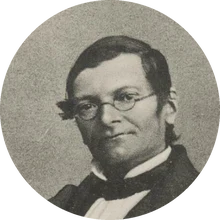
French Protestant Bibles — Louis Segond translates afresh
At the request of the Company of Pastors of Geneva, Louis Segond translates the Old Testament from the Hebrew (1874) and then the New from the Greek (1880). For the first time since Olivétan, a French Protestant Bible is not a revision but a new translation.
-
French Catholic Bibles — The Crampon Bible
Canon Augustin Crampon translates, on the Catholic side, from the Hebrew and the Greek and no longer from the Vulgate: a turning point, half a century before Rome officially encourages it (Divino afflante Spiritu, 1943).
-
French Protestant Bibles — Segond 1910 and the Synodal Bible
The British Bible Society publishes the revision of Segond that will bear his name, “Segond 1910”, the version quoted in the French edition of this journey; the same year sees the appearance of the Synodal Bible of the Reformed Churches. The Segond 1910 becomes the Bible of all French-speaking Protestantism, evangelicals included.
Jewish and Christian WitnessesThree variants you can check for yourself1 John 5 · Mark 16 · Luke 4: comparative table
The manuscripts recovered by Tischendorf and his successors led translators to remove, or to flag, a few passages which the Bibles of the Reformation read. The Bible reader on this page lets you see this for yourself in a few clicks: open each reference and choose “Compare”.
| Passage | Olivétan 1535 | Segond 1910 | NBS, Semeur | Tischendorf’s Greek |
|---|---|---|---|---|
| : “in heaven, the Father, the Word, and the Holy Ghost” (King James Version) | present | absent | absent | absent |
| : the longer ending of Mark | read without any marking | read without any marking | in square brackets | printed |
| : “to heal the brokenhearted” (King James Version) | present | present | absent | absent |
The clause in 1 John 5:7 comes from late Latin manuscripts; Erasmus introduced it into his Greek New Testament in 1522, from which it passed into Olivétan. Faith in the Trinity does not rest upon this verse: the companion journey “Trinity” (in French) shows which texts it is founded on. The ending of Mark is missing from the two great fourth-century codices, which stop at verse 8.
Fact: these differences come from the manuscripts, not from the translators; all of them are flagged in study Bibles.
Fact: none of them touches a central point of the Christian faith.
Interpretation: the weight to be given to the ancient manuscripts (Sinaiticus, Vaticanus) as against the Byzantine majority text remains a matter of debate, including among evangelicals.
Bible verses are quoted from the Berean Standard Bible (BSB), or from the King James Version where stated; the French editions are read on the author’s Bible server. Jewish texts read on Sefaria, Christian texts on TheologAI; unless otherwise stated, their English renderings are free translations made for this journey.
The History of the Bible · a timeline in nine panels · 2026 editionVII — IX
Panel Eight · 1947–2000
The twentieth century: Qumran, Jerusalem, ecumenism
The discovery at the Dead Sea confirms the Hebrew text; Catholics and Protestants at last translate together; Bibles multiply for different readerships.
-
Manuscripts, scholarship and textual criticism — The Dead Sea Scrolls
A Bedouin shepherd finds the first jars. The Great Isaiah Scroll, a thousand years older than the Leningrad Codex, agrees with it in essentials; the differences are mostly matters of spelling. Qumran also reveals other forms of the text, including the one the Septuagint translates (a shorter Jeremiah).
-
French Catholic Bibles — The Bible de Jérusalem
The Dominicans of the École biblique de Jérusalem publish, in a single volume, a translation from the original languages, with introductions and scholarly notes. It becomes the standard Catholic Bible in French.
-
French Catholic Bibles — The TOB, the ecumenical translation
Catholics, Protestants and Orthodox translate together; the New Testament appears in 1972, the whole Bible in 1975. For the first time since the Reformation, one and the same French text is received by all the confessions.
-
French Protestant Bibles — The Colombe and the Bible en français courant
The revised Segond known as the “Colombe” (1978) modernises the Segond for the evangelical and Reformed churches. The Bible en français courant (1982), from the Alliance biblique, seeks plain language for all.
-
French Protestant Bibles — The Semeur and the Parole de Vie
The Bible du Semeur (1992, revised 2015), an evangelical translation in contemporary French, and the Parole de Vie (2000), in basic French, widen the choice available to readers. Study Bibles multiply.
-
Manuscripts, scholarship and textual criticism — Nestle-Aland 27 and 28
The critical edition of the Greek New Testament, the fruit of a century’s work on more than 5,000 manuscripts, serves as the basis for almost every modern translation. The text has never been more securely established.
The History of the Bible · a timeline in nine panels · 2026 editionVIII — IX
Panel Nine · 2000–2026
Today: a Bible for every reader
New translations, screens and phones, and a worldwide movement so that every language may have its own Scripture: the story that began with leather scrolls goes on.
-
French Protestant Bibles — The Nouvelle Bible Segond and the Segond 21
The Nouvelle Bible Segond (2002), extensively annotated, and the Segond 21 (2007), “the original in today’s words”, carry on the Segond line for the evangelical and Reformed churches. In 2019, the Nouvelle Français courant renews the Bible of 1982.
-
The wider world: printing, Bible societies and every language — The Bible in your pocket
Bible apps put dozens of translations, including the Segond 1910, on every phone; the facsimiles of 1535 can be leafed through online. Never has Scripture been so accessible, nor so easy to compare.
-
French Catholic Bibles — The revised TOB
The ecumenical translation receives a complete revision and six additional books recognised by the Orthodox Churches: the common text widens further.
-
The wider world: printing, Bible societies and every language — Every language
In 2024, the complete Bible exists in more than 750 languages and the New Testament in more than 1,700 others. As at 1 August 2025, 544 of the 7,396 living languages are still waiting for translation to begin: the task begun in Alexandria is not finished.
-
French Protestant Bibles — Receive, examine, pass on
“We are all heirs of those who went before us; each in turn receives, examines, reforms and passes on.” From Moses to your phone, the same Word; in every generation, the same responsibility (; ).
The History of the Bible · a timeline in nine panels · 2026 editionIX — IX
After the timelineFive key points.
From the scribes who counted every letter to the Qumran scrolls, which confirm, in all essentials, a thousand years of copying, the Bible is the best-attested book of antiquity: more than 5,000 Greek manuscripts for the New Testament alone.
The synagogues were already translating into Aramaic (the targums), and the Septuagint had put the Old Testament into Greek two centuries before Jesus; Jerome translated it into Latin from the Hebrew; Waldo, Wycliffe, Lefèvre and Olivétan did the same for the people. Reading in one’s own language is no modern invention.
Olivétan’s Bible inherits from Lefèvre and from the Septuagint as much as from Erasmus, and it opens the line that runs from the French Geneva Bible through Martin and Ostervald to Segond. The companion journey “Olivétan 1535” (in French) lets you read it.
From Louvain (1550) to Crampon and the Bible de Jérusalem, Catholics in turn have translated from the original languages; the TOB (1975) is the first French Bible received by all the confessions.
More than 750 languages have the complete Bible, but 544 languages are still waiting for a first translation. Receive, examine, pass on: the motto of the dossier holds good for the Bible itself.
Frequently asked questionsWhat people often ask.
Who decided which books would be in the Bible?
For the Old Testament, Jesus speaks of “the Law of Moses, the Prophets, and the Psalms” (); the Mishnah shows that the rabbis were still debating the Song of Songs and Ecclesiastes, and the Talmud (Bava Batra 14b) fixes the order of the Prophets and the Writings. For the New Testament, the Churches received the Gospels and the apostolic letters very early; the second-century lists (Muratori) and the letter of Athanasius (367) do not create the canon, they record what was already being read everywhere. The books known as apocryphal or deuterocanonical, present in the Septuagint but absent from the Hebrew Bible, are the point on which Catholics and Protestants have diverged since Olivétan, who set them apart: see the box “The apocryphal books” on Panel V.
Has the text been altered in the course of copying?
Variants exist, as in any text copied by hand over centuries, but they are known, catalogued and almost all minor (spelling, word order). No central doctrine depends on an isolated variant; the best known (; John 7:53–8:11; ) are flagged in modern Bibles: see the box “Three variants” on Panel VII. The discoveries of Qumran and of the Sinaiticus have brought the text closer to the originals, not further away.
Why so many French translations?
Because the language changes, because knowledge of the manuscripts advances, and because readerships differ: study calls for literalness (Darby, NBS), everyday reading calls for clarity (Semeur, Parole de Vie), the liturgy calls for beauty. Comparing them, as the Bible reader on this page makes possible, is an enrichment, not a source of confusion.
Which is the “best” Bible?
The one you actually read. For a French-speaking reader, the Segond 1910 remains the common foundation; the Segond 21 or the NBS bring it up to date; the TOB gives a voice to all the Christian traditions. The essential thing, as Olivétan already said in his Apologie, is that the text should reach the reader and that the reader should be able to judge.
SourcesFurther reading.
- The twelve clickable Bible passages give the Berean Standard Bible (BSB) and the King James Version, both in the public domain and read on bolls.life, followed by the French editions read on the author’s Bible server: Segond 1910 (public domain), with the Nouvelle Bible Segond (© Société biblique française), the Bible du Semeur (© Biblica / Excelsis), Parole de Vie (© Alliance biblique française), Darby (1890) and the working transcription of Olivétan 1535; Hebrew from the Leningrad Codex and Greek from Tischendorf with Strong’s numbers.
- Jewish witnesses (Sefaria): Babylonian Talmud, Nedarim 37b, Megillah 3a and 9a, Kiddushin 30a, Bava Batra 14b; Mishnah, Yadayim 3:5; tractate Soferim 1:7. Christian witnesses (TheologAI): Augustine, On Christian Doctrine II, 15 (NPNF, 1887); Council of Trent, Session IV; Belgic Confession, art. 6; Thirty-Nine Articles, art. 6; Westminster Confession, ch. 1. Augustine is quoted in the NPNF translation (1887), the Thirty-Nine Articles and the Westminster Confession in their original English; the other English renderings are free translations.
- Online facsimiles: Olivétan Bible, 1535 (e-rara) · Codex Sinaiticus · Dead Sea Scrolls (Israel Museum) · Gallica for the Bible historiale, Lefèvre d’Étaples, Sacy, Martin and Ostervald.
- Translation statistics: Wycliffe Global Alliance, Global Scripture Access 2025 (544 of 7,396 languages still waiting as at 1 August 2025) and the 2024 report (more than 750 languages with a complete Bible).
- Historical reference points: notes from the International Museum of the Reformation (Geneva), the Bibliothèque de Genève and the Alliance biblique française; critical editions Biblia Hebraica Stuttgartensia and Nestle-Aland (28th edn, 2012).
- Portrait credits (public domain, Wikimedia Commons): Erasmus by Holbein (workshop, c. 1530); Jerome by Ghirlandaio (Ognissanti, 1480); Gutenberg, sixteenth-century engraving; Lefèvre d’Étaples, print (Rijksmuseum); Tyndale, early engraving; Robert Estienne, print (BnF); Theodore Beza, engraving; Lemaistre de Sacy by Philippe de Champaigne (Port-Royal); Ostervald, engraving; Tischendorf, photograph c. 1870; Louis Segond, photograph. Title page of the 1535 Bible: Internet Archive / e-rara. The other medallions come from the main dossier. All are unified on screen by a sepia wash.
- Typography: Cormorant Garamond (headings) and Spectral (body text), under the SIL Open Font Licence, served from this site.
- Related companion journeys: Olivétan 1535 (read the first French Bible; in French) and the dossier Where Do Our Protestant Churches Come From? (the timeline of the Churches, whose template this site reuses).